Between Presence and Display: Sacred Objects and the Making of Collectability in South Korea
By Koni Kim
When does a sacred object become collectible? The question sounds straightforward, but in practice it opens onto a series of others. Who decides? Under what conditions? And does the sacred object itself, in some meaningful sense, have a say in the matter?
These questions are explored through two Korean Buddhist sculptures: the Gilt-bronze Pensive Bodhisattva (National Treasure No. 83) and the Gilt-bronze Seated Ksitigarbha Bodhisattva (Treasure No. 279). Both are state-designated cultural properties; both have been drawn into systems of collection. Yet they now occupy strikingly different regimes of visibility. To follow their diverging histories is to observe how collections form – and, equally, how they fail to form – around objects whose original purpose was not to be owned, but to be venerated.
Collecting the Sacred: What can be collected?
What defines the boundary between a vessel of divine agency and a candidate for museum acquisition? To designate the sacred as ‘collectible’ within the modern museum is to initiate a conceptual displacement, distinct from the sacred assemblages of votive offerings, relic collections and temple treasuries that have long constituted devotional forms of accumulation in their own right. The concern here is not with collecting per se, but with the reclassification of sacred objects once removed from ritual contexts and absorbed into secular institutional frameworks. In this process, the numinous, once encountered within ritual frameworks, undergoes what Malraux (1965:11–12) called a ‘metamorphosis’, re-emerging as image through regimes of rarity, provenance and material significance. Yet such selection is never neutral. It involves institutional judgements that determine which forms of the sacred are rendered preservable within the secular archive, and how they circulate within economies of value and exchange (Pearce 1999:157–159).
In South Korea, this transition has at times produced visible tensions between sacred agency and secular classification. Such tensions were particularly evident in the Buddhist sculpture galleries of the National Museum of Korea during the late twentieth century, where acts of veneration before displayed statues were not uncommon. Banknotes and coins accumulated at the bases of objects reclassified as works of art [1]. Such practices did not simply signal religious persistence; they exposed an unstable boundary that the museum’s framing had not fully contained. Collections, in this sense, remain contested sites where classification and divine presence coexist uneasily, and at times in open conflict.
As Buddhist temples in South Korea began establishing museum spaces within their compounds, these tensions acquired a sharper institutional edge. The incorporation of sacred objects into temple museums is not a straightforward passage from sacred to secular, but an ongoing negotiation, one made especially visible through the controversy over a jigsaw puzzle produced by the Tongdosa Museum in the early 2000s [2].
Established in 1987 and relocated in 1999 to a purpose-built facility within the temple grounds, the museum at one point reproduced the image of a Buddhist statue as a souvenir jigsaw puzzle made available for sale at the site. This transformation of a sacred figure into a marketable cultural commodity met with resistance from devotees, who regarded the fragmentation of the Buddha’s body as sacrilegious.
Within the temple museum, the Buddhist image is approached simultaneously as a museum object and as a sacred presence demanding reverence. The tension is not incidental; it reveals how the adoption of museum practices within devotional contexts generates questions that neither curatorial protocols nor religious frameworks can fully resolve. Collection, in this context, remains suspended between institutional practice and the obligation to venerate.
The Gilt-bronze Pensive Bodhisattva (NT 83): From sacred image to museum object
The Image as Form
Standing at 93.5 cm, the gilt-bronze pensive bodhisattva is among the largest extant examples of its kind in South Korea and is widely regarded as a defining work of the Korean pensive tradition (Fig. 1). The figure is generally identified as Maitreya, the Buddha of the Future, expected to descend and bring salvation to all sentient beings.
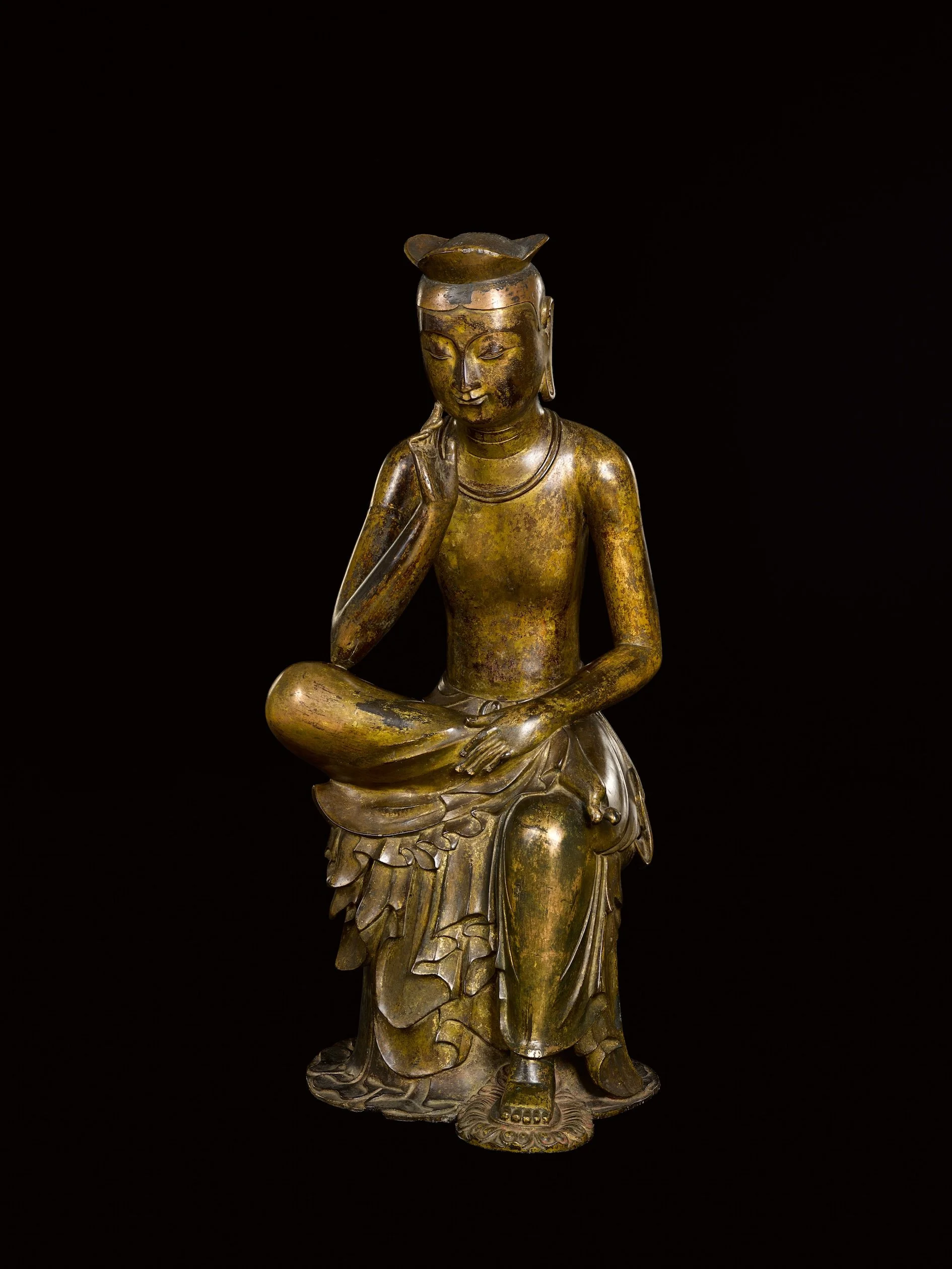
Figure 1. The Gilt-bronze Pensive Bodhisattva (NT 83). © National Museum of Korea
Its iconography follows the canonical pensive posture: the right leg crosses over the left knee, while the fingers of the right hand lightly touch the cheek, reinforcing its contemplative character. The face carries a serene smile, and the bare upper torso is adorned with a simple two-strand necklace. Thin robes drape the lower body, revealing subtle contours beneath, while a lotus pedestal supports the figure’s left foot. A metal protrusion at the back of the head indicates that a nimbus was once attached, now lost.
The sculpture demonstrates a high degree of technical refinement, its devotional purpose remaining immediately legible. Its formal coherence reflects the convergence of skilled craftsmanship and established iconographic conventions within workshop-based production processes commonly associated with such objects.
The figure is generally attributed to the late Three Kingdoms period (57 BC–668 CE), though its precise origins remain uncertain. Housed in the National Museum of Korea in Seoul, it is displayed as a canonical work in Korean art history, occupying a particular position within national narratives of cultural identity.
Confronting a lost narrative
The early history of the pensive bodhisattva (NT 83) is marked by archival silence. No contemporaneous records of its discovery or early circulation have been identified, and a widely repeated oral account placing its discovery in Gyeongju during the 1920s remains unverified.
The absence of secure provenance cannot be attributed to a single cause, nor should it be read as simple neglect. It must be understood within a broader historical condition: during the Japanese colonial period, many Korean cultural objects were displaced, recontextualised or removed without systematic documentation. Within this condition of archival fragility, gaps in the sculpture’s early history appear not as anomalies but as structural consequences of a particular historical moment.
A partial reconstruction is offered in the writings of Su-yong Hwang (2022:50–54), former Director-General of the National Museum of Korea. Drawing on oral testimony gathered from residents and monks in the Gyeongju area, Hwang describes the sculpture’s discovery by a local couple – Mr Kim and his wife, Mrs Oh – whilst digging on the western slopes of Namsan, in the valley known as Seonbanggok. He situates this episode in the late nineteenth to early twentieth century, noting that the couple are said to have enshrined the figure within their home, dedicating a room to its veneration and performing daily acts of devotion. The figure thus appears not as an inert object but as a living sacred presence within domestic ritual life – an account that, while unverified, points to an early phase of intimate ritual engagement.
This period of domestic veneration was reportedly brought to an end by the arrival of several Japanese visitors, who are said to have lingered near the shrine room before departing. When Mrs Oh entered the room at dawn the following day to make her morning offering, the sculpture was no longer there. Whether this was indeed the pensive bodhisattva cannot be confirmed. A detail recorded at the time of its acquisition by the Yi Royal Household Museum in 1912 (Kwangpyo Lee 2020; Kihwan Lee 2021) is nonetheless suggestive of a possible connection. The figure had been painted white, with blackened brows and reddened lips. Only when it was washed in warm water did its gilt surface reappear. Mrs Oh is said to have spent the remainder of her life in grief, dying in the years after the Korean War without ever recovering what she had regarded as divine (Hwang 2022:53–54).
Whether read as fact or retrospective construction, this narrative carries the structure of colonial displacement: a sacred object removed from its ritual ecology and rendered mobile within external circuits of value and possession. This structure finds a parallel in the documented trajectory of the gilt-bronze pensive bodhisattva. Existing records indicate that the sculpture was acquired in 1912 by the Yi Royal Household Museum through the Japanese art dealer Kajiyama Yoshihide (Kwangpyo Lee 2020; Kihwan Lee 2021), suggesting its passage through Japanese-mediated commercial networks prior to institutional acquisition. It was later transferred to the National Museum of Korea and, in December 1962, designated ‘National Treasure No. 83’.
What these accounts reveal, taken together, is a shifting ontology as the object moves across distinct regimes of value: from sacred embodiment to domestic devotional icon, to colonial commodity, to a museum object and state-recognised cultural asset. This trajectory resonates with Igor Kopytoff’s (1986:65) notion of the ‘cultural biography of things’, illustrating how objects are continually redefined as they oscillate between commodity and singularised cultural object. Its incorporation into museum collections and its articulation within Korean art history do not close that movement but reconfigure it. The sculpture continues to circulate as a contemporary cultural commodity, notably through mass-produced miniature reproductions (Fig. 2), around which new regimes of value quietly accumulate [3].
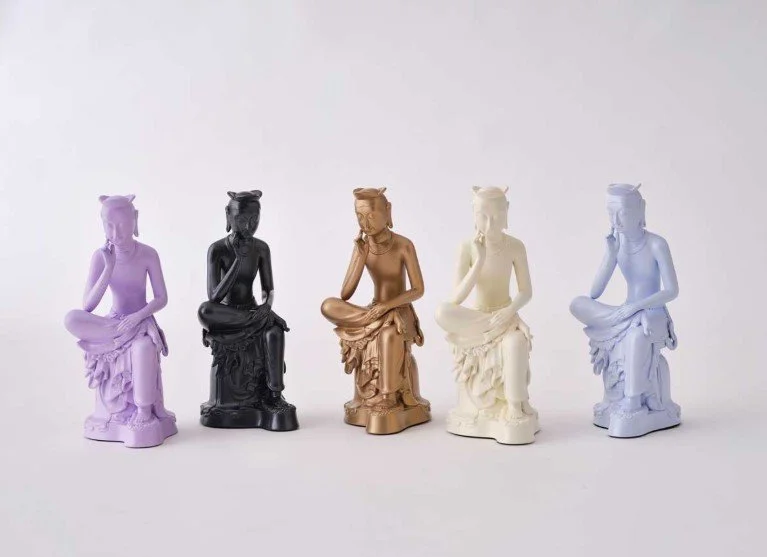
Figure 2. Miniatures of the Gilt-bronze Pensive Bodhisattva (NT 83). © National Museum Goods MU:DS
The Gilt-bronze Seated Ksitigarbha Bodhisattva (T 279): From living practice to an uncollectable yet displayable sacred object
The Image as Form
Standing at 83 cm, the seated Ksitigarbha bodhisattva (T 279) embodies salvific resolve, in contrast to the contemplative interiority of the pensive bodhisattva (NT 83). Ksitigarbha, the Bodhisattva of the Great Vow, has pledged not to attain Buddhahood until all sentient beings are liberated from the sufferings of hell (Fig. 3).
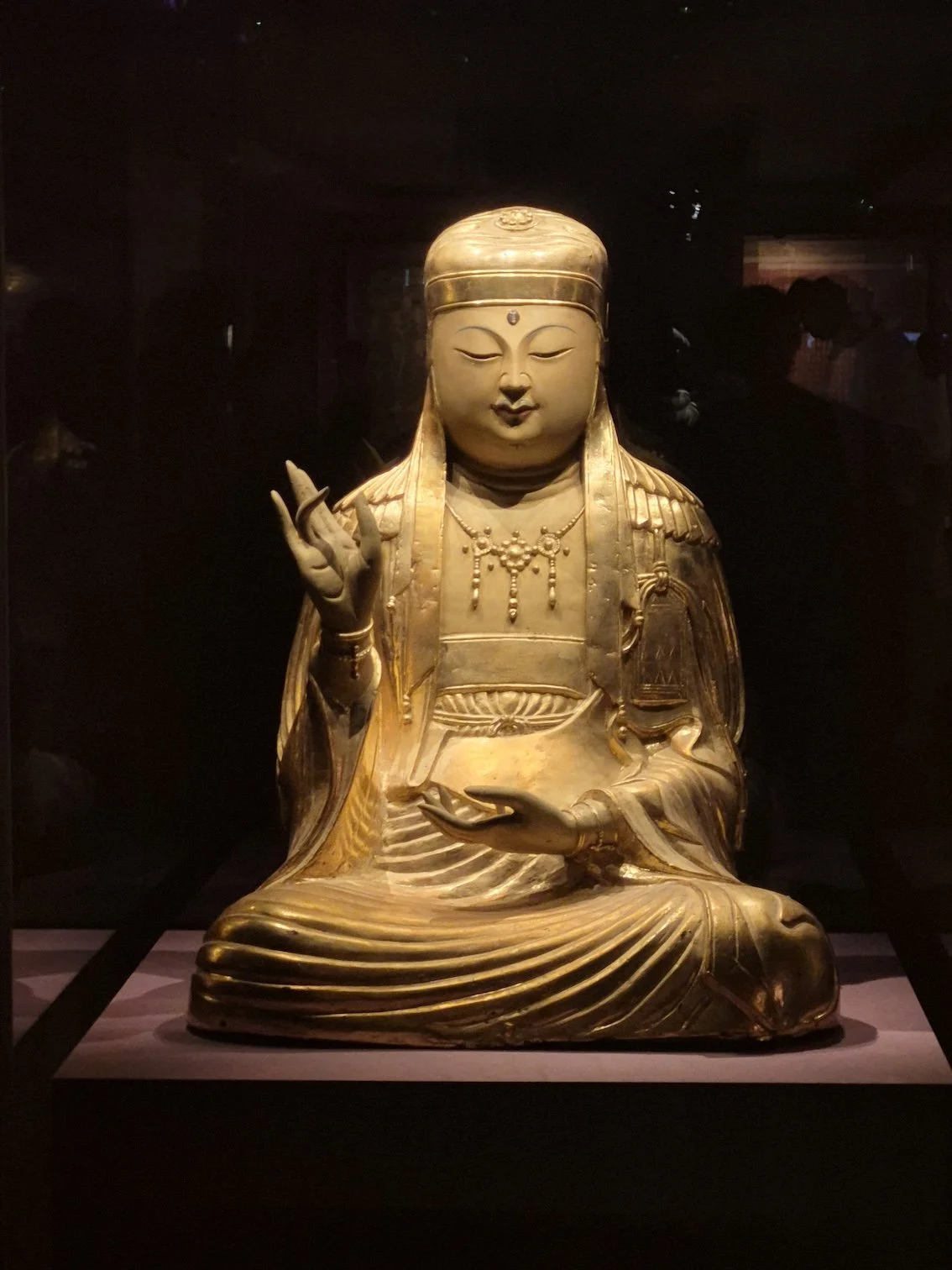
Figure 3. The Gilt-bronze Seated Ksitigarbha Bodhisattva (T 279), Seonunsa Temple. © Koni Kim
The iconography is defined by a hood and a thick band encircling the forehead and covering the ears, its ends descending toward the abdomen. The figure’s broad, rounded face carries finely rendered features, producing an expression of grounded compassion rather than contemplative withdrawal. The torso is enveloped in heavy, decorative robes that prioritise formal density over bodily articulation. The hands form a clearly articulated mudra: the right raised to the shoulder, the left resting near the abdomen, with gently curved fingers. Together, these features present the bodhisattva not in inward retreat but in an active orientation toward the protection and guidance of suffering beings.
The statue is generally attributed to the early Joseon period and reflects the transition from the fluid elegance of the Goryeo dynasty (918–1392) to the more restrained and decorative visual language of early Joseon Buddhist sculpture. It is currently housed at Seonunsa Temple in Gochang, where it remains an active presence within a living religious context – neither fully objectified nor fully detached from devotional life.
Reconstructing a displaced narrative
In contrast to the gilt-bronze pensive bodhisattva (NT 83), whose provenance remains irretrievable in the absence of contemporaneous documentation, the gilt-bronze seated Ksitigarbha bodhisattva (T 279) is distinguished by a comparatively continuous historical trajectory. This legibility is inseparable from Seonunsa Temple, traditionally associated with its origin, founded during the reign of King Jinheung of the Silla Kingdom (r. 540–576) and rebuilt in 1613. Within this monastic framework, stylistic analysis situates the statue in the early Joseon period. Beyond this art-historical attribution, it has remained, for most of its history, an active presence within a living religious context.
That continuity was broken in 1936, under Japanese colonial rule, when the statue was removed from Seonunsa Temple and transferred to Japan. What was displaced was not only a physical object, but the conditions of its ritual presence, embedded in centuries of devotional practice. What followed is among the more remarkable episodes in the history of Korean Buddhist objects.
Accounts from the period of the statue’s circulation in Japan describe successive possessors experiencing misfortune – illness, financial loss and ill-luck – understood within local idioms as karmic consequences [4]. The bodhisattva (T 279) was also said to have appeared repeatedly in dreams, demanding return to its original temple. When this injunction was ignored, misfortune followed; the statue was subsequently transferred from one holder to another, yet the same pattern recurred with each new possessor. Eventually, the final holder felt compelled to contact Gochang Police Station, requesting that the statue be returned.
Whether understood as religious experience or as retrospective narrative construction, these accounts share a consistent logic: the statue was not available for private possession. It belonged elsewhere, and that claim was persistently asserted. The object thus remains embedded within a narrative of sustained interpretive agency.
In November 1938, monks from Seonunsa Temple travelled to Hiroshima together with officers from Gochang Police Station to retrieve the statue and escort it home (Fig. 4; Sukhee Lee 2018). The return was not merely a logistical operation but a performative restoration of the relation between image and place.
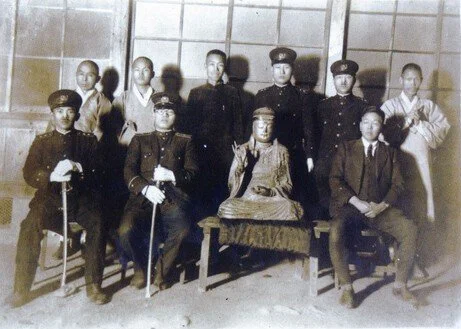
Figure 4. Repatriation of the Gilt-bronze Seated Ksitigarbha Bodhisattva (T 279), Hiroshima, November 1938. Source: Sukhee Lee (2018)
Displacement here does not appear as rupture alone, but as a condition generating its own counter-movement. Its status was formalised in January 1963, when it was designated Treasure No. 279.
Since its return, the statue has moved between contexts without fully settling. It was enshrined in Gwaneumjeon, a hall dedicated to Avalokitesvara bodhisattva, before being transferred to the Seonunsa Seongbo Museum in 1998 (Ahn 2010), and relocated in 2019 to Jijangjeon, a hall dedicated specifically to Ksitigarbha (Jeong 2019), thereby aligning its ritual placement more closely with its iconographic identity. The sequence reveals not spatial stability but a persistent oscillation between iconographic identity, ritual function and institutional classification. The statue does not settle into either museum object or ritual icon; it moves between regimes of visibility and devotion, sustaining a shifting relationship between presence and display shaped by institutional framing and ritual intervention. Rather than becoming fully collectible, it persists as a ritual presence that resists full incorporation into possession.
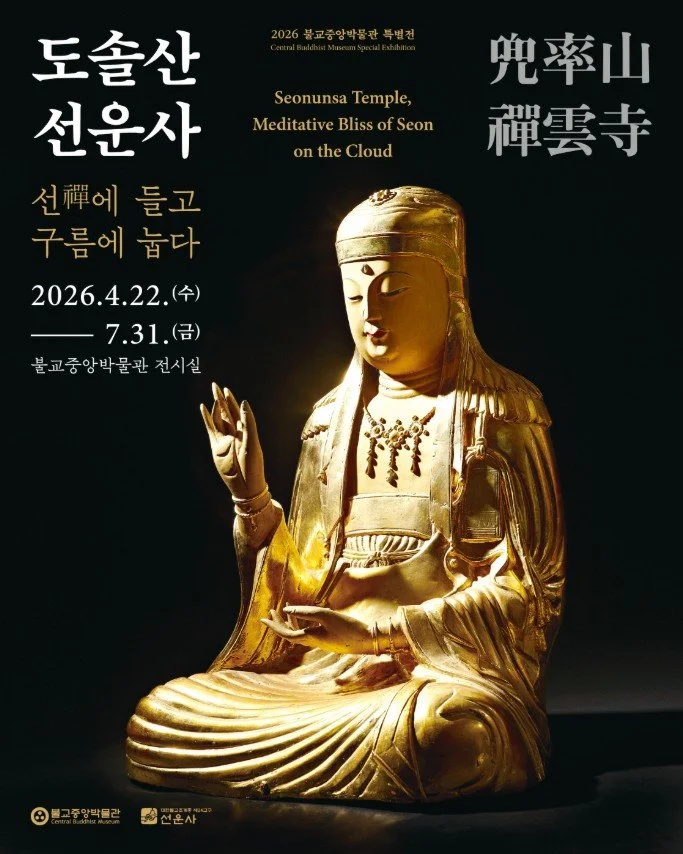
Figure 5. Poster for the special exhibition Seonunsa Temple, Meditative Bliss of Seon on the Cloud. © Central Buddhist Museum
This negotiation became especially visible in the special exhibition Seonunsa Temple, Meditative Bliss of Seon on the Cloud, held at the Central Buddhist Museum in Seoul (21 April–31 July 2026) (Fig. 5), as the following discussion will show. The exhibition coincided with the reopening of the museum following a fire in June 2025, marking its first exhibition staged in the restored building. For the first time, three Ksitigarbha bodhisattva statues from Seonunsa Temple – including T 279 – were brought together in a single display (Fig. 6; Yeo 2026). The museum is located within the precincts of Jogyesa Temple and operates through conventional curatorial protocols that recontextualise sacred figures as exhibition objects. The opening did not proceed as a purely secular cultural event.
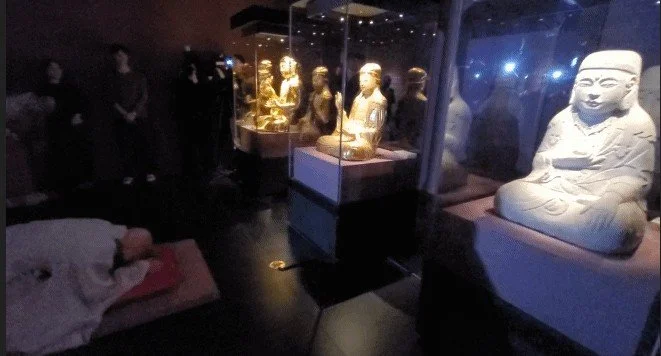
Figure 6. Opening ceremony of the special exhibition showing three Ksitigarbha Bodhisattva statues from Seonunsa Temple displayed together for the first time, with a monk prostrating before them, Central Buddhist Museum (2026). Source: Yeo (2026)
The image of the Ksitigarbha bodhisattva, understood as a sacred embodiment of the divine, undergoes a transformation as it moves from the temple to the museum, where its sacrality is reconfigured within regimes of visual consumption. As Gaskell (2003:150) observes, once a sacred object is removed to a secular space, its sacred qualities are not simply preserved under glass; the exhibitionary frame reconfigures them, orienting these objects toward aesthetic and art-historical reception rather than devotional engagement. Yet this reconfiguration does not entail the complete erasure of sacrality. Rather, ritual practices intervene, sustaining the legibility of sacred presence even within institutional settings that simultaneously produce them as objects of display.
This framing is unsettled across two distinct moments. Prior to the opening, a sequence of ritual actions accompanied the transfer of sacred Buddhist objects from Seonunsa Temple to the museum – from preparation and offering within the temple, through procession and transport, to a post-installation ceremony at the museum itself (Figs. 7–9, with video footage below).
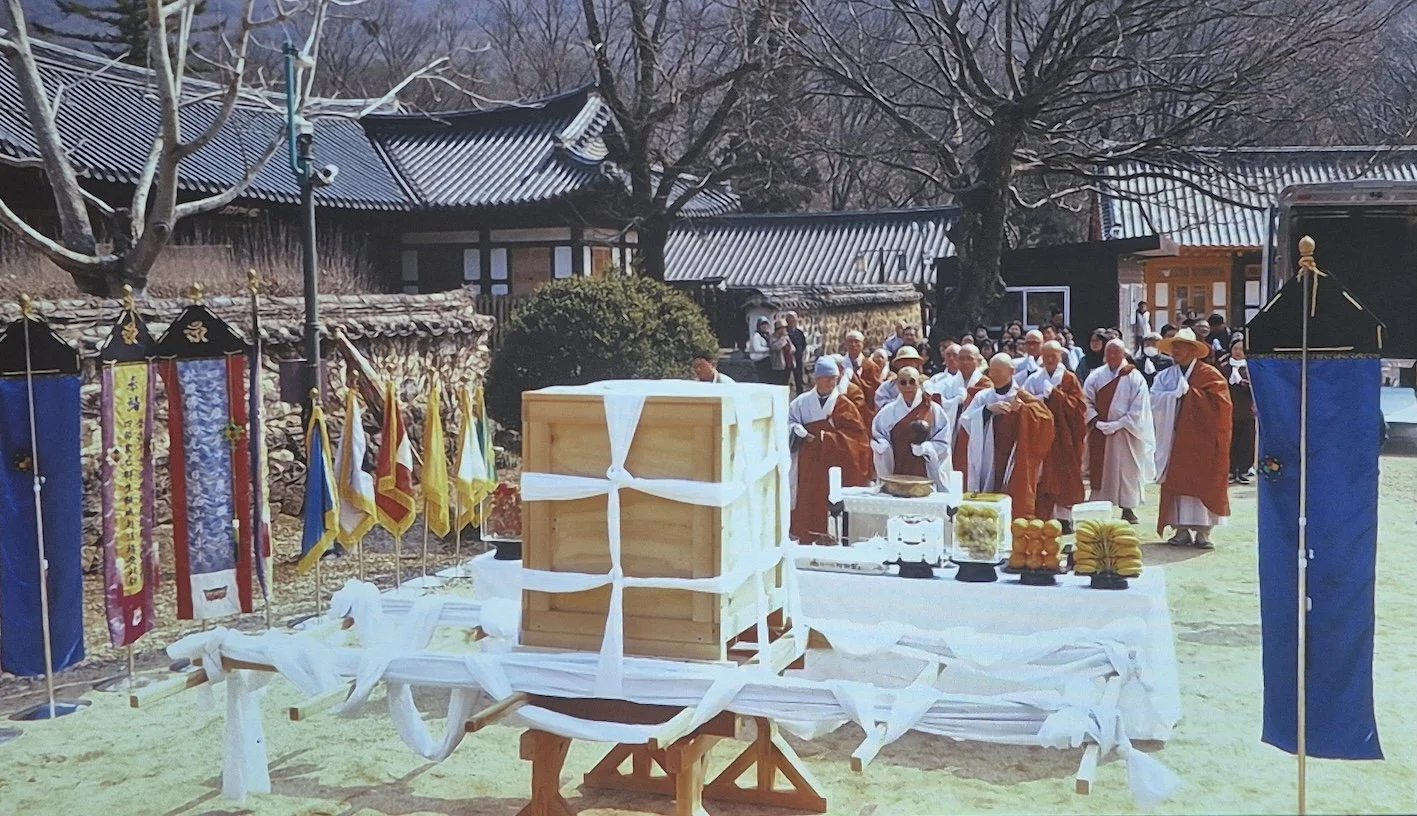
Figure 7. Ritual offering in front of a wooden transport crate at Seonunsa Temple prior to transfer. Still from exhibition video, Central Buddhist Museum (2026). Photo: Koni Kim
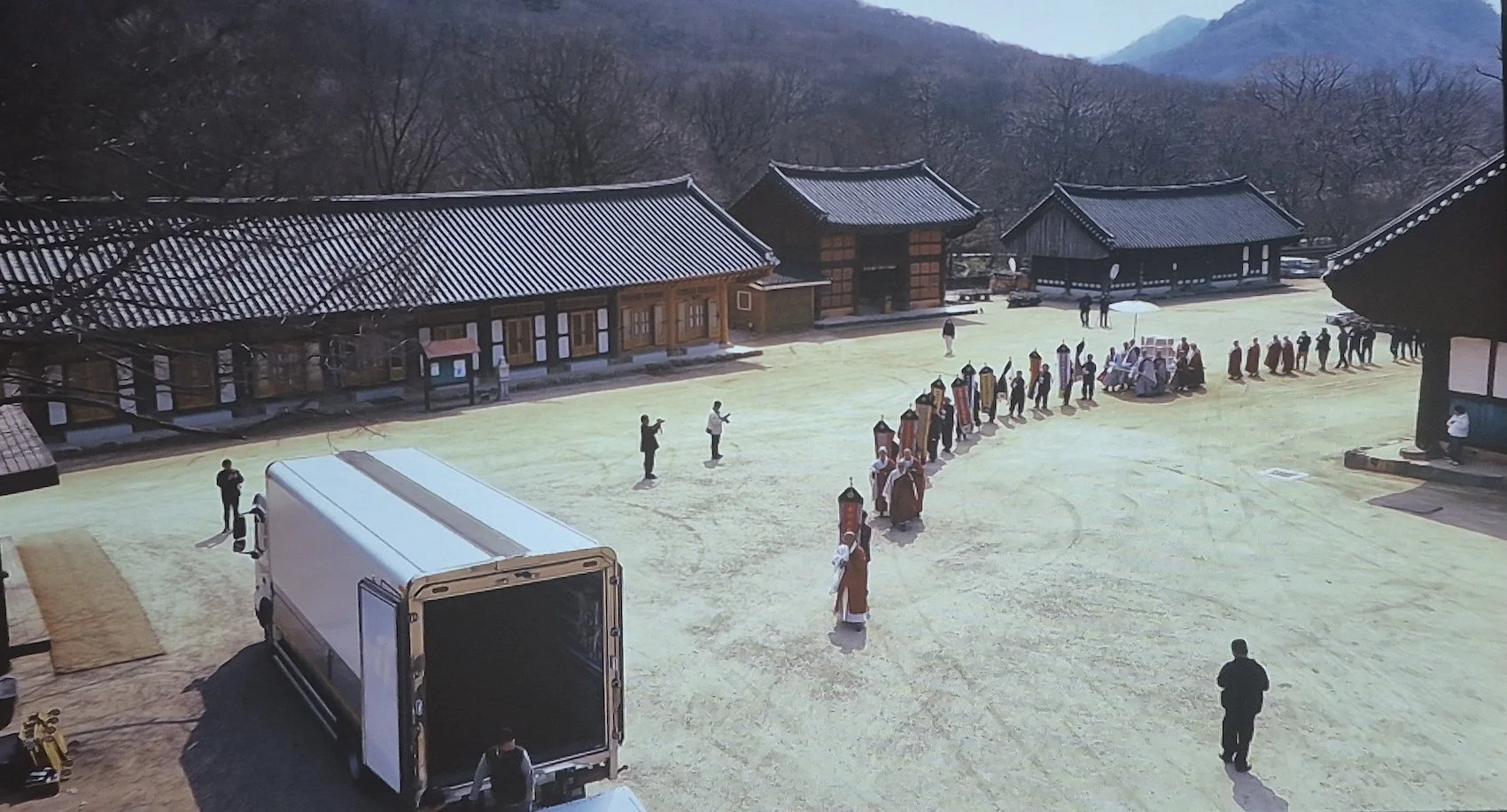
Figure 8. Procession escorting a sealed crate to the transport vehicle. Still from exhibition video, Central Buddhist Museum (2026). Photo: Koni Kim
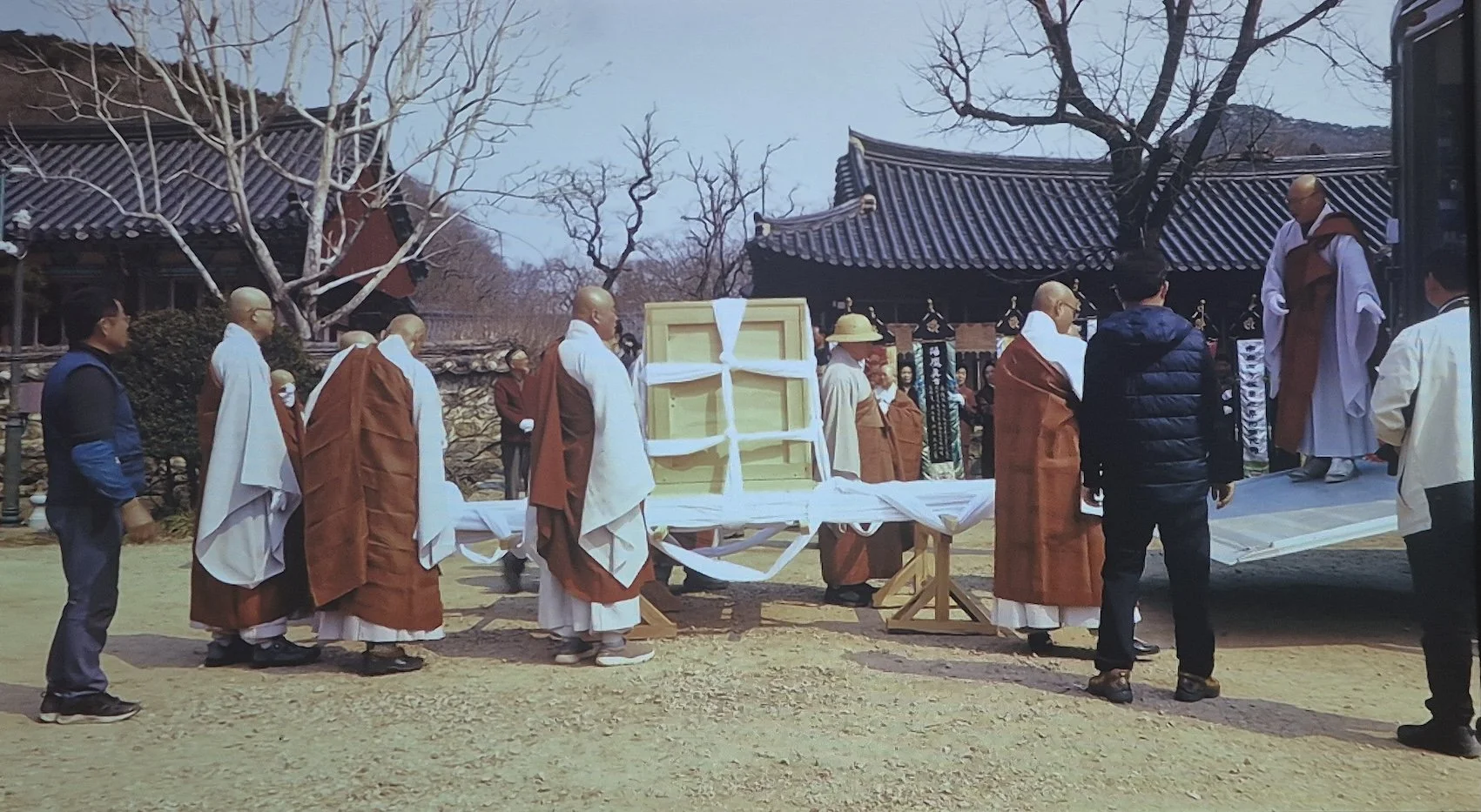
Figure 9. Loading of a sealed crate onto the transport vehicle. Still from exhibition video, Central Buddhist Museum (2026). Photo: Koni Kim
Video: Ritual offering following the transfer and installation of sacred Buddhist relics, Central Buddhist Museum, 2026. © Jogye Order of Korean Buddhism
Their relocation into the museum repositions the relics within an exhibitionary regime of visual consumption, in which their sacral status becomes precarious without being entirely effaced. The ritual offering does not simply restore a prior sacred presence; rather, it operates as a form of mediation through which sacrality remains legible within an institutional field that simultaneously produces these figures as objects of display.
At the opening ceremony itself, monks from Jogyesa Temple and Seonunsa Temple prostrated before the statues, reintroducing ritual address into the gallery space (Fig. 6). Seobong Sunim, director of the museum, described the gathering of the three statues in terms of compassion, consolation and hope (Yeo 2026). Devotional language, in other words, continued to inflect institutional framing.
Across these two moments, what emerges is not a linear transformation from sacred object to museum object, but a dual register in which the figures oscillate between devotional presence and exhibitionary objecthood, sustaining a relationship between presence and display shaped by both institutional framing and ritual intervention. Within the gallery itself, this duality is quietly confirmed: Buddhist visitors place offerings in the donation box before the Ksitigarbha bodhisattva, join their palms and pray (Fig. 10) – acts of devotion that persist within the exhibitionary frame without fully disrupting it [5].
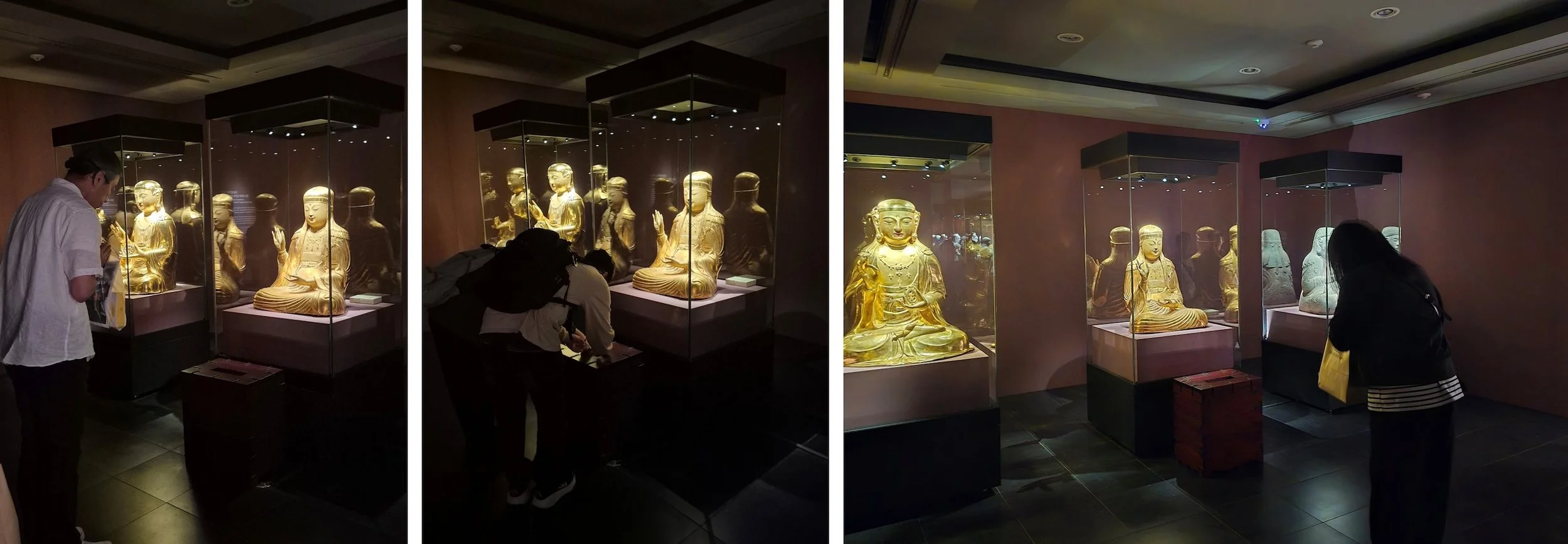
Figure 10. Devotees bowing and making offerings before the Gilt-bronze Seated Ksitigarbha Bodhisattva (T 279), Central Buddhist Museum, 2026. Photo: Koni Kim
In this sense, the seated Ksitigarbha bodhisattva (T 279) is neither mere artefact nor purely icon. It is displayable, but not fully collectible. It moves between temple and gallery, between devotional presence and exhibition object, without being reducible to either. This oscillation articulates a tension between visibility and possession.
Conclusion
The diverging histories of these two gilt-bronze sculptures illuminate different possibilities within the broader process through which sacred objects move into, and circulate through, museum and exhibitionary institutions.
The gilt-bronze pensive bodhisattva (NT 83) has been absorbed into a national collection. Its provenance, being undocumented, is treated as a matter of historical loss. Its identity as a canonical work of Korean art has become primary. What it once meant to those who enshrined it in a domestic room and venerated it daily is largely beyond recovery.
The gilt-bronze seated Ksitigarbha bodhisattva (T 279) has resisted that absorption. Its history carries a logic of return – a sustained assertion that possession, in the ordinary sense, was never quite possible. It has been classified, designated and temporarily displayed, but it continues to circulate within a living ritual context, and those who care for it continue to use devotional rather than purely curatorial language to describe what it is.
What emerges from these two biographies is a reminder that sacred objects do not simply become collectible. They are drawn into – and sometimes draw back from – systems of value, classification and institutional authority, in ways that reflect the pressures of history, the interests of collectors and states, and the resilience of the communities that have long regarded them as something other than objects to be owned. The question of when the divine becomes collectible is not resolved at a single historical threshold. It re-emerges, across these two trajectories, as an ongoing condition.
Notes
[1] Observed in the late 1980s–1990s.
[2] Oral interview with a curator at the Tongdosa Museum, conducted in the early 2000s in connection with the transportation of Buddhist artefacts for an exhibition.
[3] Miniatures of the sculpture are sold through the National Museum of Korea’s shop and online commercial platforms, extending its circulation as a contemporary cultural commodity beyond the physical museum space. Their visibility was significantly amplified after RM, a member of the South Korean boy band BTS, purchased the miniature and shared images on social media – an act that reportedly triggered a rapid increase in demand, leading to expanded production (Xportsnews 2025). Although these reproductions have not generated controversy comparable to debates surrounding the commercialisation of other sacred images – such as the decontextualisation of sacred images into commodities that involve the physical fragmentation of the Buddha’s body, as in jigsaw puzzles – their circulation nonetheless marks a further metamorphosis in the object’s cultural biography, in which sacred form becomes further entangled with commodity culture, digital circulation, and affective attachment structured through contemporary celebrity fandom. This process also extends into the visual language of global consumer culture. Officially licensed miniature variants presented through the National Museum of Korea’s MU:DS programme and exhibited at the Korean Cultural Center Los Angeles (7 May–7 July 2026) reinterpret the sculpture’s contemplative hand gesture through the affective vocabulary of contemporary Korean popular culture, including finger-heart and thumbs-up gestures (JTBC 2026; Korean Cultural Center Los Angeles 2026).
[4] This episode appears in multiple Korean newspaper reports concerning the seated Ksitigarbha bodhisattva statue (see, for example, Sukhee Lee 2018; Yeo 2026) and in an interpretive video presented in the special exhibition Seonunsa Temple, Meditative Bliss of Seon on the Cloud, held at the Central Buddhist Museum in Seoul from 21 April to 31 July 2026.
[5] Observed 24 April and 2 May 2026.
References
Ahn, Housang (안후상) (2010) ‘고창 선운사 금동지장보살좌상 [Seated gilt-bronze Bodhisattva Statue of Seonunsa, Gochang]’, 디지털고창문화대전 (The Digital Encyclopedia of Gohang) at https://www.grandculture.net/gochang/dir/GC02800505.
Gaskell, Ivan (2003) ‘Sacred to Profane and Back Again’, in Andrew McClellan (ed.) Art and its publics : museum studies at the millennium, Malden, MA : Blackwel, pp. 149-162.
Hwang, Su-yong (황수영) (2022) 반가사유상 [The Pensive Bodhisattva], repr., Seoul: 대원사 (Daewonsa).
Jeong, Jongsin (정종신) (2019) ‘선운사 금동지장보살좌상 “신축” 지장전 봉안 [Gilt-bronze Ksitigarbha Bodhisattva enshrined in Seonunsa’s newly constructed Jijangjeon]’, BBS News at https://news.bbsi.co.kr/news/articleView.html?idxno=919181.
JTBC News (2026) ‘손하트 날리는 반가사유상에 환호…LA 찾은 “K-힙” 뮷즈 [Pensive Bodhisattva Miniatures with Finger-Heart Gestures Featured in Los Angeles “K-Hip” MU:DS Exhibition]’, 11 May at https://www.youtube.com/watch?v=9VRK26K3Tig.
Kopytoff, Igor (1986) ‘The Cultural Biography of Things: Commoditization as Process’, in Arjun Appadurai, Arjun (ed.) The Social Life of Things: Commodities in Cultural Perspective, Cambridge: Cambridge University Press, pp. 64–91.
Korean Cultural Center Los Angeles (2026) ‘MU:DS, K-Culture Unboxed in Los Angeles’, 2 May at https://la.korean-culture.org/en/1896/board/1492/read/144021.
Lee, Kihwan (이기환) (2021) ‘“4mm의 반전매력”…1500년간 “흠결” 숨긴 78호 반가사유상 [“The Unexpected Charm of 4mm”: The Pensive Bodhisattva (No. 78) That Concealed Its “Flaws” for 1,500 Years]’, 경향신문 (The Kyunghyang Shinmun), 23 February at https://www.khan.co.kr/article/202102230600011.
Lee, Kwangpyo (이광표) (2020) ‘금동반가사유상 ‘라이벌’ 국보의 양보 없는 대결 [The Rivalry Between National Treasures No. 78 and No. 83: Twin Masterpieces of the Gilt-bronze Pensive Bodhisattva]’, 신동아 (Shindonga), 5 June at https://shindonga.donga.com/culture/article/all/13/2081999/1.
Lee, Sukhee (이숙희) (2018) ‘선운사 금동지장보살좌상 [Gilt-bronze Seated Ksitigarbha Bodhisattva of Seonunsa]’, 법보신문 (The Beopbo Shinmun), 27 March at https://www.beopbo.com/news/articleView.html?idxno=102693.
Malraux, André (1965) Le musée imaginaire, Paris: Gallimard.
Pearce, Susan (1999) Interpreting Objects and Collections, repr., London and New York: Routledge.
Xportsnews (2025) ‘National Museum official thanks RM as BTS collab draws global fans’, The Korea Times, 24 July at https://www.koreatimes.co.kr/entertainment/others/20250724/national-museum-official-thanks-rm-as-bts-collab-draws-global-fans.
Yeo, Taedong (여태동) (2026) ‘영험 가득한 “선운사 삼지장보살상” 서울에 나투시다 [“Full of spiritual efficacy”: The three Ksitigarbha Bodhisattvas of Seonunsa manifest in Seoul]’, 불교신문 (The Bulgyo Shinmun), 21 April at https://www.ibulgyo.com/news/articleView.html?idxno=437580.
Koni Kim is President of the Serin Research Centre for Culture & Arts. She previously served as Head of the Department of Entertainment Management (later restructured as Culture & Arts Management) at Seoul Digital University. Her research and professional work focus on museum studies and practice, with particular attention to the interpretation of material culture and museum communication.
She has conducted policy research and authored institutional reports commissioned by the Ministry of Culture, Sports and Tourism and national and public museum institutions. She has also been involved in museum establishment projects commissioned by the same ministry and local governments, contributing to policy research and institutional development processes.
She served as an advisory committee member at several public and national museums. She also served as an examiner for curatorial recruitment examinations and as a member of a review panel for museum studies examination questions in the national civil service examination. She has taught museology at several universities and is currently engaged in scholarly writing and translation in museum studies.